How to Choose EVA Foam for Packaging
Choosing EVA foam for packaging starts with the product, transport risks and the way the package will be used. Density alone is not enough: thickness, hardness, cavity design, processing and the outer case or carton work together. The safest sourcing process is to define the application, compare representative samples and record the approved specification before bulk production.
Start with the product and handling risks
Record the product dimensions, weight, fragile points and surface areas that must not be marked. Describe whether the package is for shipping, storage, display or a reusable case. Drop, vibration, repeated handling and stacking or compression risks should be considered separately.
- Product weight, overall dimensions and center of gravity
- Fragile components, protrusions and sensitive finishes
- Expected shipping and handling route
- Whether the package is single-use or reusable
- Case, carton or container dimensions
- Required packing quantity and destination
Choose density, hardness and thickness together
A firmer foam may help hold a heavy item in position, while a softer option may allow more controlled deformation around a delicate product. The required thickness depends on product weight, available clearance and the loading conditions. Selecting the highest density is not automatically safer: material that is too firm can transfer force, while material that is too soft can compress excessively.
Density and hardness are different specifications and should be reviewed independently. See the EVA foam density guide for a practical explanation of density, hardness, thickness and sample approval.
Define the insert construction
- Single-layer inserts: suitable when one material and depth can provide the required fit.
- Laminated constructions: combine layers for depth, color contrast, appearance or different functions.
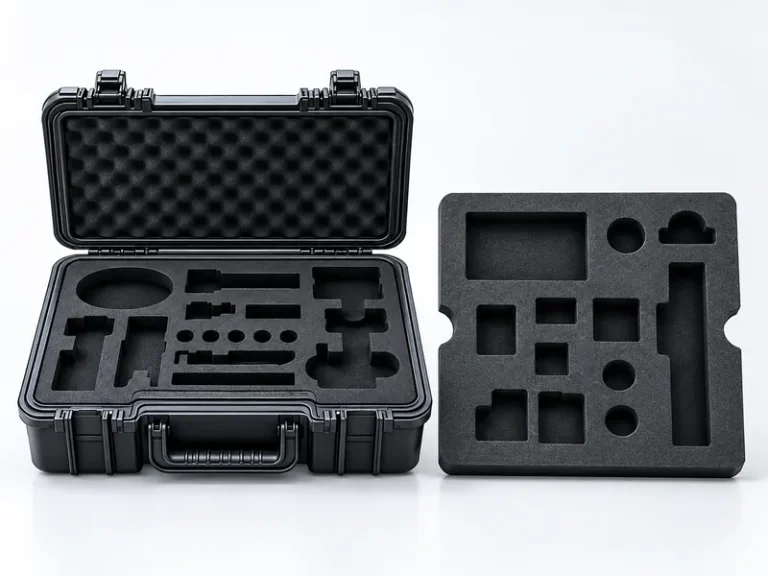
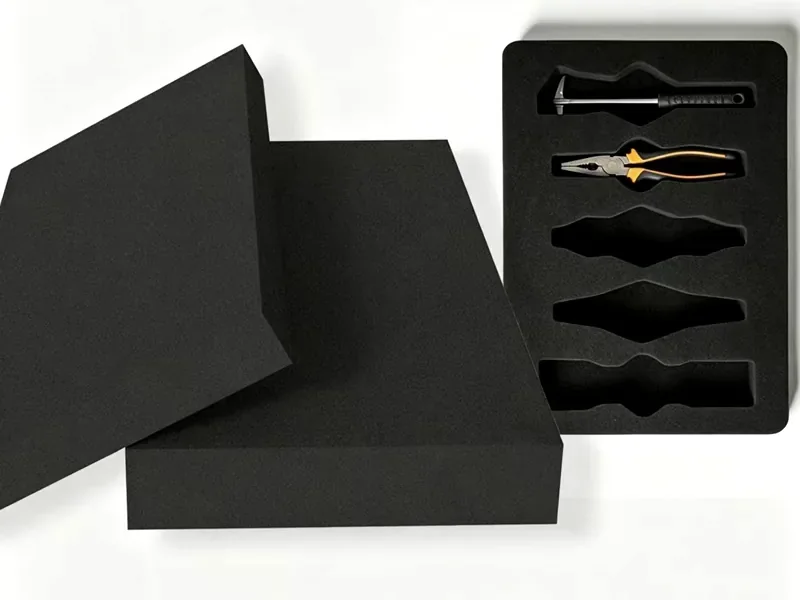
- Cavities and pockets: locate the product and control movement without creating difficult removal points.
- Finger notches and lift points: make removal easier without forcing the user to pull on a fragile component.
- Adhesive backing or case bonding: should be confirmed for the selected foam, substrate and use conditions.
- Lids and top pads: may be used to control vertical movement and protect the upper surface.
Select an appropriate cutting process
Die cutting can be efficient for repeat parts with suitable geometry and volume. CNC routing is useful for deeper cavities, prototypes and shapes that require controlled depth. Other fabrication steps may include laminating, adhesive backing, printing or assembly. The process should follow the drawing, tolerances, material thickness and required appearance rather than being chosen by price alone.
Compare CNC vs die cutting for EVA foam, then review the available custom EVA processing capabilities.
Check the fit before approving production
A cavity should hold the product securely without creating damaging pressure or making removal unnecessarily difficult. Check clearance around connectors, switches and fragile edges. Confirm that the case or carton closes correctly and that accessories remain separated during handling.
| Sample check | What to review |
|---|---|
| Fit | Product location, movement, cavity dimensions and removal |
| Cushioning | Foam thickness and response under a representative load |
| Appearance | Color, surface, cut quality, layers, graphics and cleanliness |
| Case function | Closure, lid pressure, accessory placement and carrying orientation |
| Specification | Material, dimensions, tolerances, adhesive, packing and approved sample reference |
Send complete quotation information
Provide drawings in an available CAD or vector format, product and case dimensions, expected quantity, color, packing method and any project-specific documentation requirements. If drawings are not ready, clear photographs and measured dimensions can support an initial review, but a confirmed drawing or physical sample is normally needed before final production approval.
- Product and case drawings or measured dimensions
- Product weight and fragile areas
- Required insert quantity and target schedule
- Preferred color, surface and layer construction
- Logo, printing, adhesive or packaging requirements
- Destination country and required order documentation
Common mistakes to avoid
- Choosing density without considering hardness and thickness
- Using a cavity that fits the drawing but is difficult to load or unload
- Ignoring lid pressure and the orientation of the case during transport
- Approving only a photograph instead of a physical sample where fit is critical
- Changing material, dimensions or adhesive without updating the approved specification
Frequently asked questions
Is higher-density EVA always better for packaging?
No. The correct material must be matched to the product, available thickness and expected load. A representative sample should be checked.
Can an insert be made from a product sample?
A physical product sample can support measurement and fit checks. Drawings are still useful for dimensions, tolerances and revision control.
Should I approve a prototype before bulk production?
Yes when fit, appearance or cushioning is important. Keep the approved sample together with the written production specification.
Discuss Your Packaging Project
Explore custom EVA inserts and packaging, read the custom insert guide, or send your project details for review.